Pachali Bhairab Jatra (Tepa Jatra)
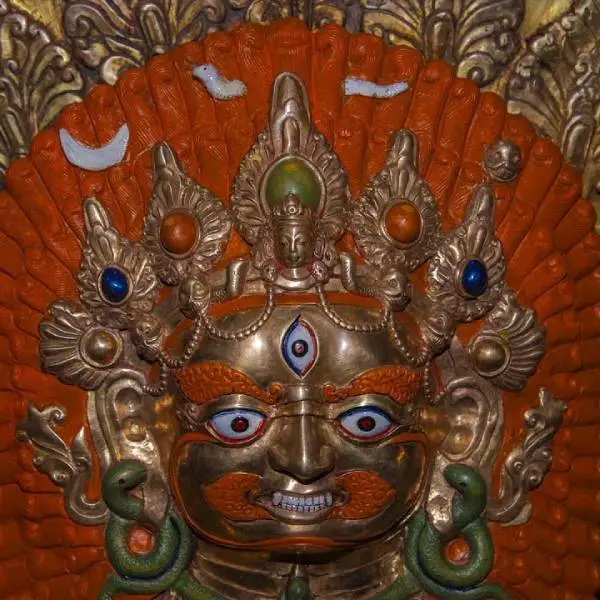
Along the banks of the Bagmati River near Teku, in the southern part of old Kathmandu, stands one of the valley's most historically significant Bhairav shrines. It is here that the Pachali Bhairav Tepa Jatra unfolds each year, a Newar festival dedicated to Pachali Bhairav, a fierce and powerful manifestation of Lord Shiva closely tied to the very founding mythology of Kathmandu itself.
Bhairav, in Hindu and Newar tradition, represents the wrathful aspect of Shiva, a deity associated with destruction, protection, and the boundary between order and chaos. Chronicles generally credit the Thakuri king Gunakamadev, who is said to have reigned between 924 and 1008 A.D., with establishing the worship of Pachali Bhairav in the Kathmandu Valley. Local tradition also links this same royal figure to a remarkable list of religious innovations, as he is further credited with bringing the worship of the Nava Durga to the valley, founding the festival of Indra Jatra, and introducing the ceremonial Lakhe dances still performed in Kathmandu today. This deep historical association places Pachali Bhairav among the oldest and most foundational deities in the valley's religious landscape.
The temple itself carries a distinctive, almost otherworldly character. Unlike the grand, multi-tiered pagoda structures that dominate much of Kathmandu's religious architecture, the Pachali Bhairav shrine is built around the base of a large, ancient pipal tree, with the sacred stone representing the deity nestled directly among the tree's sprawling roots within an open-air sanctuary. Surrounding stones are said to represent Bhairav's divine attendants, while a separate shrine dedicated to Betal, another fearsome guardian figure, stands facing the main altar, reinforcing the site's atmosphere of ancient, untamed sanctity.
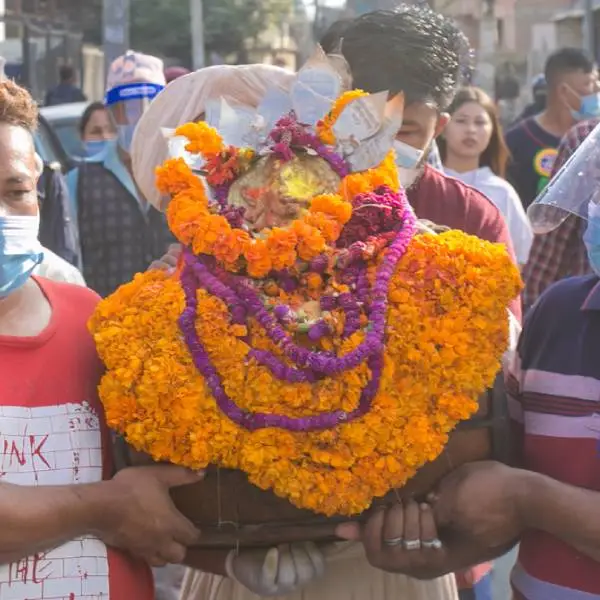
The primary celebration, often referred to locally as Tepa Jatra, is traditionally observed by the Jyapu community, the indigenous Newar farming caste whose agricultural labor has historically sustained the Kathmandu Valley. The festival typically falls on the fourth or fifth day of Dashain, Nepal's most significant national festival, situating Pachali Bhairav's celebration within the broader wave of autumn festivities that sweep across the country each year. On the night before the main day of celebration, a sacred kalash, a ceremonial water vessel bearing the painted face of Bhairav, is carried to the shrine, marking the beginning of the ritual observances.
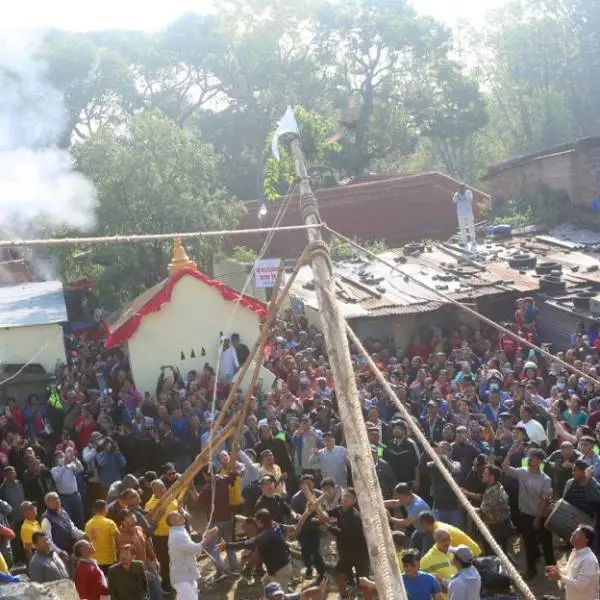
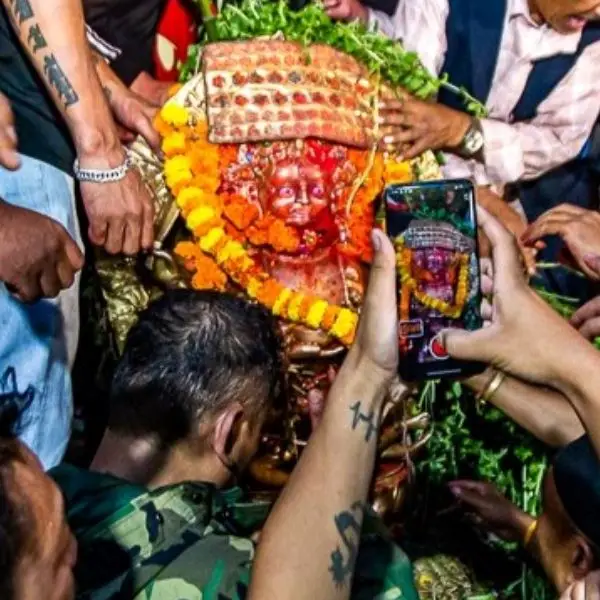
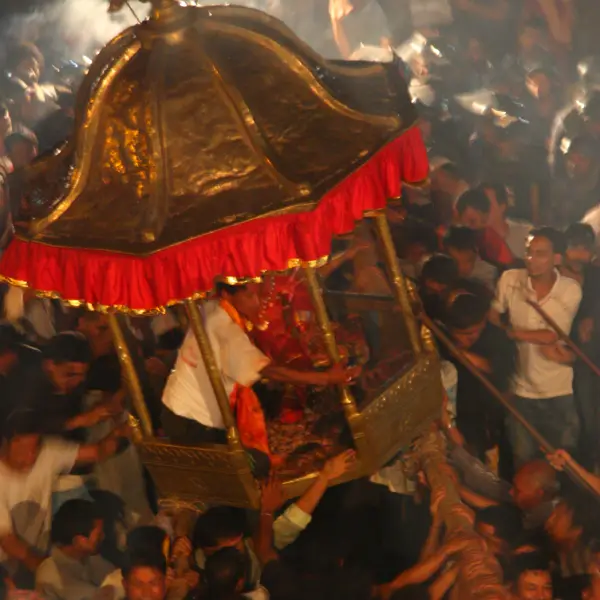
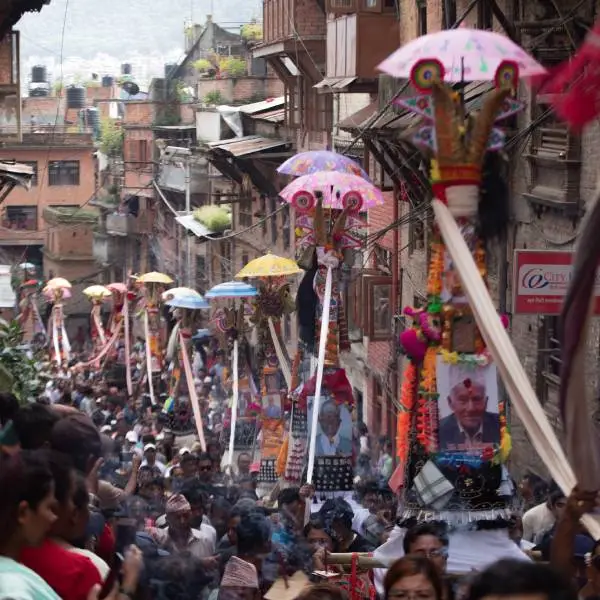
On the day of the jatra itself, various local deities are ceremonially carried in procession to Teku in honor of Pachali Bhairav, accompanied by the sounds of traditional music and the energetic participation of devotees from across the surrounding neighborhoods. Devotees offer prayers, flowers, and food, including meat and traditional rice beer known as jaad, reflecting the tantric and non-vegetarian ritual practices associated with fierce protective deities like Bhairav within Newar religious tradition. One particularly distinctive element of the celebration involves a ritual procession in which one devotee dons the mask of Bhairav while another wears the mask of his consort Ajima, and the two walk together through the streets of Kathmandu, a tradition rooted in local legend describing the goddess's desire to be publicly honored alongside her husband.
The temple's connection to political history adds another layer of significance to the festival. Centuries ago, following the historical division of Kathmandu into northern and southern halves, Pachali Bhairav played a role in rituals meant to maintain social order between the two sections of the city. Even after this political division was formally dissolved in the late fifteenth century, elements of the associated rituals persisted. Remarkably, descendants of the former royal family of Patan, now residing in the Mangal Bazaar area and known as the Bhairav Malla family, continue to send a ceremonial puja tray to the temple each year in the deity's honor, a tradition that has endured for generations despite the disappearance of the monarchy that originally established it.
Beyond the main Dashain-season jatra, the temple also draws large crowds, particularly of women, during the festival of Rishi Panchami, when the entire surrounding area takes on a festive atmosphere filled with singing and dancing. Notably, the temple remains free and open to visitors of any background, with no entrance fee required, making it an accessible site for travelers curious about Kathmandu's lesser-visited but historically rich religious traditions.
For those exploring the older, less touristic quarters of Kathmandu, the Pachali Bhairav Tepa Jatra offers a compelling glimpse into a form of devotion that predates much of the city's more famous religious architecture. Rooted in royal legend, agricultural community life, and centuries-old ritual practice, the festival stands as a living connection to the earliest chapters of Kathmandu's history, honoring a deity whose presence has watched over the city since its earliest days.