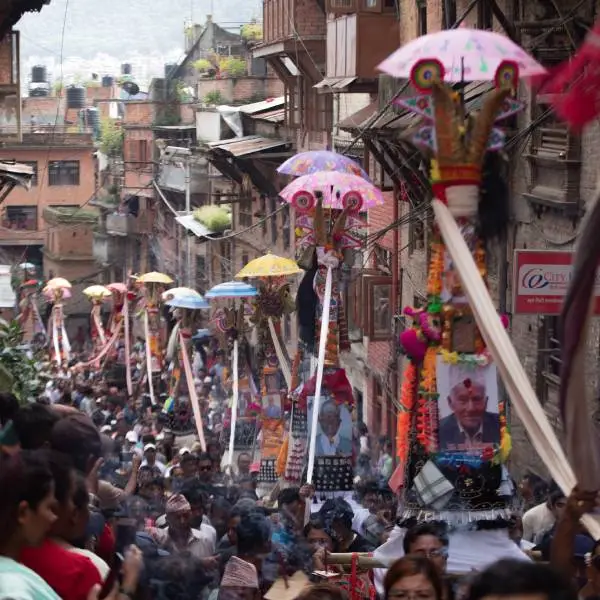
Nhee Gaa Jatra
Nhee Gaa Jatra, commonly referred to as Saatgaule Jatra, is a traditional Newar festival celebrated in the southwestern part of the Kathmandu Valley. The celebration connects communities around Kirtipur and Chandragiri through temple worship, ceremonial chariots, music, family gatherings, and communal feasts. At the centre of the tradition is Bishnu Devi, whose shrine becomes an important meeting point during the festival. Local accounts describe the participating deities as members of one symbolic family who travel from their respective communities to visit the mother goddess. This idea of reunion gives Nhee Gaa Jatra a character that is both religious and deeply social.
The festival is known by several related names, including Nhe Gaa, Nhyaga, Bakhumad Jatra, and Saatgaule Jatra. The term Saatgaule literally points to a celebration associated with seven villages or settlements. Historical community boundaries and modern place names do not always match neatly, which explains why different descriptions provide somewhat different lists of participating settlements. Kirtipur, Panga, Nagau, Machhegaun, Boshigaun, Satungal and nearby communities repeatedly appear in accounts of the wider festival tradition.
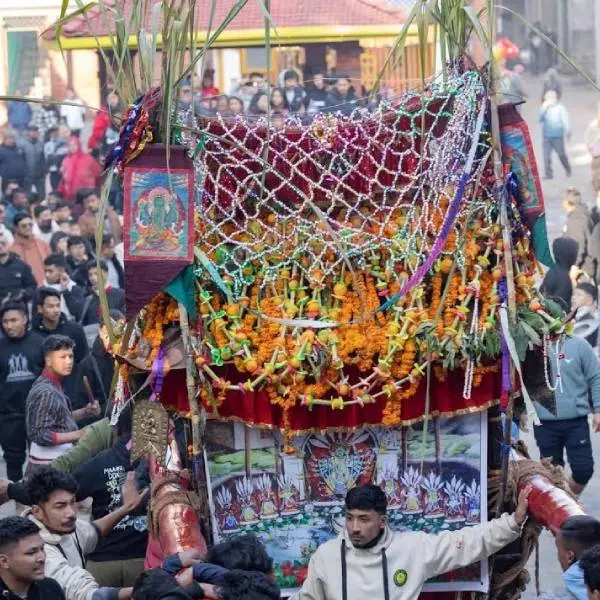
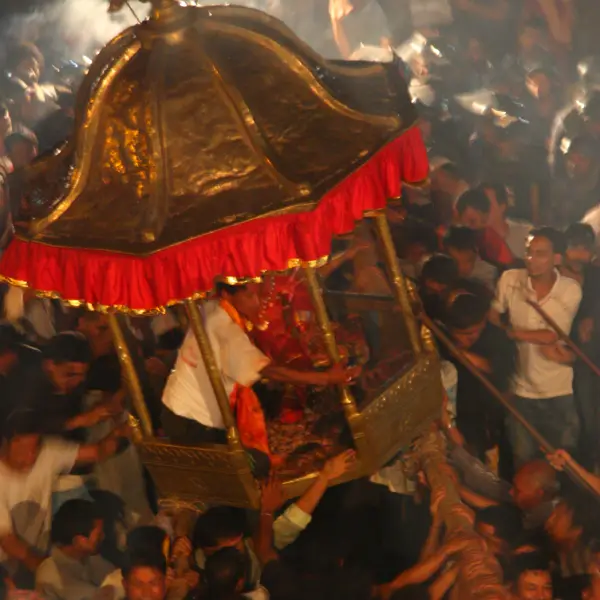
What matters more than the precise modern boundary is the relationship between these communities. Each settlement maintains its own deity, shrine, guthi responsibilities, procession practices, and festival schedule. During Nhee Gaa Jatra, those separate traditions become part of a larger ritual network. Sacred images are placed on decorated khats, or portable chariots, and carried by local participants accompanied by traditional instruments. The movement of the deities turns roads and neighbourhood spaces into temporary ceremonial routes.
A widely told local belief describes Bishnu Devi as the mother, with deities from neighbouring settlements regarded symbolically as her children. During the annual celebration, they journey toward her shrine as though returning home for a family gathering. This religious story gives the festival an unusually familiar emotional quality. Rather than presenting divine figures only as distant objects of worship, the tradition imagines them through relationships that people immediately recognise: mother, children, siblings, visits, waiting, and reunion.
One local story even explains differences in the order in which the chariots approach the shrine through sibling rivalry. Versions vary between communities, yet the underlying idea remains memorable: the gods arrive almost like members of an extended household gathering after time apart. These stories have been passed through local memory and contribute to the identity of individual villages within the shared festival.
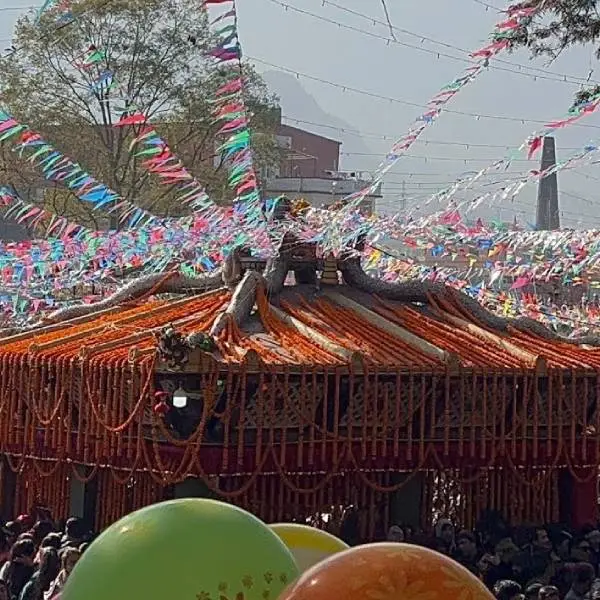
The main gatherings take place around the Bishnu Devi area near the borders of Kirtipur and Chandragiri. Chariots representing different communities are brought toward the shrine with musicians, guthi members, devotees, and residents accompanying them. After worship, the ceremonial structures may be taken around the temple area before returning to their respective neighbourhoods. The combination of several processions meeting within one religious space is one of the defining sights of Saatgaule Jatra.
Traditional Newar music plays an important role throughout the celebration. Drums, cymbals and other instruments announce approaching processions and create a rhythm for the movement of the khats. Residents gather along the route, while relatives who live elsewhere often return to their ancestral neighbourhoods for the occasion. The festival therefore renews connections not only between sacred places but also between families and communities.
Food is another important part of the winter celebration. Local descriptions mention large household and community feasts featuring traditional Newar dishes. A particularly distinctive seasonal preparation is takhā, a set meat jelly traditionally made during colder weather. Beaten rice, meat dishes, beans, pickles, curd and other foods may also be served when relatives and friends are invited to join the feast.
The timing contributes to this winter atmosphere. Local accounts place the celebration around Thilla-thwa Ashtami, Navami and Dashami, with different communities holding important rituals on different days. In 2026, the corresponding bright-fortnight Ashtami, Navami and Dashami fall around 17–19 December in Nepal’s calendar. Because procession schedules are set locally, visitors should still confirm the exact main-day programme closer to the event.
For travelers, Nhee Gaa Jatra offers a very different experience from Nepal’s nationally famous festivals. There is no single grand stage or tourist-centred programme. Instead, the experience unfolds through small settlements, local shrines, neighbourhood processions, family feasts and centuries-old community responsibilities. This makes it especially interesting for visitors who want to understand how Newar heritage continues beyond the better-known squares of central Kathmandu, Patan and Bhaktapur.
Kirtipur itself provides a rewarding setting for exploring the festival period. Traditional houses, temple courtyards, narrow lanes and elevated views over the Kathmandu Valley form the backdrop to local ritual life. Nearby settlements in the Chandragiri area add another layer, allowing visitors to see how cultural traditions connect communities that today may appear to be part of one continuous urban landscape.
Visitors should remember that the processions are acts of worship rather than performances arranged specifically for photography. Sacred chariots need room to move, musicians and guthi members should not be interrupted, and temple areas should be approached respectfully. Asking before taking close portraits is especially appropriate during prayer or ritual activity.
At its heart, Nhee Gaa Jatra in Nepal is about maintaining relationships. Deities visit one another, villages renew old bonds, relatives return for shared meals, and inherited guthi responsibilities pass from one generation to the next. Through chariot processions, winter feasts, music and worship, communities around Kirtipur and Chandragiri continue a festival whose meaning lies as much in belonging as in ceremony. For travelers interested in Nepal’s lesser-known living traditions, Saatgaule Jatra provides an intimate look at how religion, food, family memory and neighbourhood identity remain closely connected in Newar culture.
Important correction for the existing page: I would revise its fixed seven-village list. The live page names Naikap, Satungal, Boshigaun, Nunkot, Tinthana, Machhegaun and Kirtipur, while multiple local accounts describe the traditional seven-community grouping differently, including places such as Kirtipur, Panga, Nagau and Lhwakot.