Navadurga Jatra
Navadurga Jatra is one of the most visually striking and spiritually significant festivals in the Kathmandu Valley, centered in the ancient city of Bhaktapur. This indigenous tradition traces its origins to the reign of the Malla dynasty, the medieval rulers who governed the valley for centuries and left behind an extraordinary legacy of art, architecture, and religious devotion. The Mallas were deeply devoted to Shakti, the divine feminine energy believed to embody power, protection, and creation, and it was under their patronage that the worship of the Navadurga, or Nine Durgas, became formally institutionalized as both a religious practice and a performative art form.
At the heart of the festival lies a dramatic mask dance that portrays the nine distinct and fearsome manifestations of the goddess Parvati. Each of these forms, collectively known as the Navadurga, represents a different aspect of divine power and cosmic energy. The deities typically included in this pantheon are Mahakali, Kumari, Barahi, Bhairavi, Maheshwori, Brahmayani, Indrayani, Mahalaxmi, and Tripurasundari, though local traditions and specific temple lineages in Bhaktapur may present slight variations in the exact grouping. Each goddess is associated with a unique, elaborately crafted mask, painted in vivid colors and adorned with symbolic details that reflect her particular character and mythological role, ranging from serene and benevolent to ferocious and wrathful.
The creation of these masks is itself considered a sacred ritual process, not merely a craft. Traditionally, the masks are made from clay taken from specific, ritually significant locations, and their construction follows precise religious protocols passed down through generations of mask-making families. Before a mask is worn by a dancer, it is believed to be ritually empowered, transforming the wearer into a living vessel for the deity during the performance. This transformation is taken with great seriousness by the performers and the community alike; once masked, the dancers are regarded not simply as actors portraying gods, but as temporary embodiments of divine energy walking among the people.
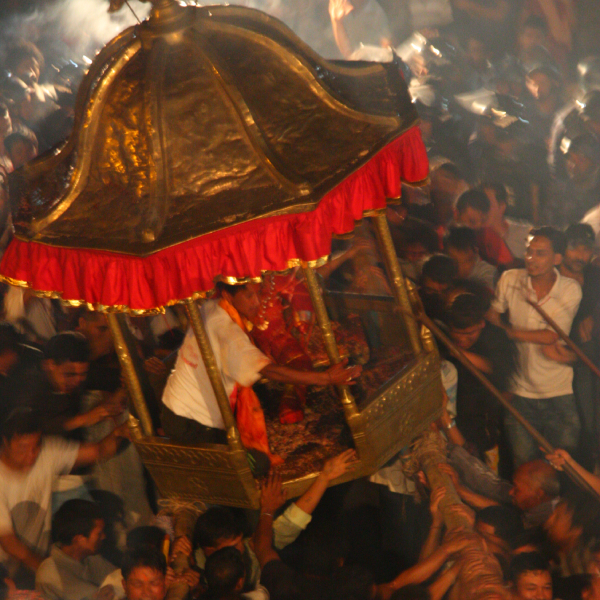
The Navadurga dance troupe traditionally performs in a specific sequence, moving through various neighborhoods and sacred sites within Bhaktapur over the course of several months, rather than confining the celebration to a single day. The performances typically begin around the time of Dashain, Nepal's largest and most important festival, which itself is dedicated to the worship of Durga, and continue in a structured cycle throughout the following months. During this period, the masked dancers visit different parts of the city, performing ritual dances at courtyards, temples, and public squares, drawing crowds of devotees and spectators eager to witness the dramatic movements, rhythmic drumming, and symbolic gestures that characterize the performance.
The dance itself is accompanied by traditional Newari music, played on instruments such as the dhime and other percussion drums, which set an intense, hypnotic rhythm that guides the choreography. The movements of each masked deity are distinct, reflecting the personality and mythological narrative associated with that particular form of the goddess. Some dances depict fierce battles against demons, echoing the central mythological narrative of Durga's triumph over evil, while others involve more subtle, ritualized gestures meant to bless the community and ward off misfortune.
For the Newar community of Bhaktapur, Navadurga Jatra is far more than a public spectacle; it is an essential component of the city's spiritual and social fabric. The festival is believed to protect the city and its residents from disease, disaster, and malevolent forces, reinforcing the ancient belief held by the Malla kings that the worship of Shakti deities safeguarded the nation, the ruler, and the people. Many households and local guilds maintain hereditary roles in organizing and performing the ritual, ensuring that the knowledge, choreography, and religious protocols associated with the festival are preserved and passed down through specific family lineages rather than being open to general participation.
For visitors to Bhaktapur, witnessing even a portion of the Navadurga Jatra offers a rare glimpse into one of the most authentic and enduring expressions of Newari religious culture. Unlike festivals designed primarily for tourism, Navadurga Jatra remains a deeply localized, community-driven tradition, rooted in centuries-old belief systems that continue to shape daily life in the ancient city. The vivid masks, hypnotic drumming, and solemn reverence surrounding the performances make it one of the most compelling living traditions in the Kathmandu Valley, offering a powerful reminder of how art, faith, and history remain intricately intertwined in Nepal's cultural heartland.
.jpg)